
Laser Eye Center of Silicon Valley has been a pioneer in implantable vision correction for over 20 years. Our surgeons performed the first EVO ICL procedure in Northern California and continue to lead the region in advanced lens-based vision correction procedures.


EVO ICL, also called an Implantable Collamer Lens, is a refractive implant to correct common vision issues like myopia (nearsightedness) with or without astigmatism. Unlike some other vision correction options, the EVO ICL is an additive technology that corrects vision without the removal of any corneal tissue. The EVO ICL is meant to reduce or eliminate the need for glasses and contacts and unlike most permanent refractive solutions, EVO ICL is removable by your doctor, for added peace of mind.
EVO ICL is made of biocompatible Collamer material that works in harmony with your eye. Your Eye doctor will create a small opening in your cornea that will be used to insert and position the EVO ICL. For most patients, the procedure is virtually painless with numbing drops and it typically takes less then 20 – 30 minutes for both eyes. Patients typically experience improved vision right away and a quick recovery time.
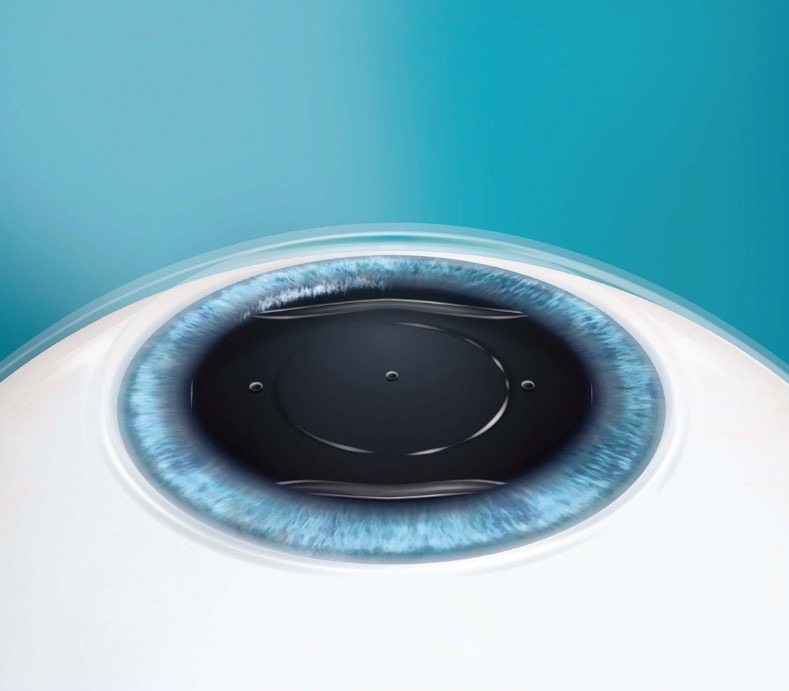

• Provides clear, sharp vision
• 20 – 30 minute procedure
• Quick recovery time
• Removable by your doctor
• Offers UV protection
• Not visible once in place
• Can treat nearsightedness with or without astigmatism
• For patients who may not be candidates for LASIK of other vision correction procedure due to thin corneas
• Does not cause dry eye syndrome
• Excellent night vision

The investment in the EVO ICL procedure is more than LASIK and by performing the procedure in our facility that difference is minimized versus having to use an outside facility. Many EVO ICL patients look forward to spending less in the long run with the EVO ICL compared to the continued cost of contacts and glasses. Ask about financing options and payment plans that may be available for your EVO ICL procedure.
EVO ICL, is well-suited for a wide variety of people. Ideal candidates for EVO ICL are at least 21 years of age with nearsightedness or without astigmatism and have maintained a stable prescription for at least one year. If you are seeking a solution to decrease or eliminate the cost and frustration of traditional contacts or glasses, EVO ICL may be your answer. Contact us to discuss if EVO ICL is right for you.

This chart breaks down the general candidacy guidelines for each procedure. During your initial consultation, your eye care professional will discuss your measurements and help you make the right choice depending on your unique vision.


The EVO ICL lens is intended to correct/reduce nearsightedness between -3.0 D up to -20.0 F and treat astigmatism from 1.0 D to 4.0 D. If you have nearsightedness within these ranges, EVO ICL surgery may improve your distance vision without eyeglasses or contact lenses, Because the EVO ICL corrects for distance vision, it does not eliminate the need for reading glasses, you may require them at some point, even if you have never worn them before. Since implantation of the EVO ICL is a surgical procedure, before considering EVO ICL surgery you should have a complete eye examination and talk with your eye care professional about EVO ICL surgery, especially the potential benefits, risks, and complications. You should discuss the time needed for healing after surgery. Complications, although rare, may include the need for additional surgical procedures, inflammation, loss of cells from the back surface of the cornea, increase in eye pressure, and cataracts, You should NOT have EVO ICL surgery if your doctor determines that 1. the shape of your eye is not appropriate, 2. you do not need the minimum endothelial cell density for your age at the time of implantations, 3. you have moderate to sever glaucoma, 4. your vision is not stable, or 5. if you are pregnant or using.
The EVO Implantable Collamer Lens is a soft, flexible lens placed behind the iris and in front of the eye’s natural lens. It corrects moderate to high nearsightedness and astigmatism without permanently removing tissue from the cornea.
The EVO ICL allows people to see without glasses and contacts (similar to LASIK) but is a different procedure in that no corneal tissue is removed. Patients report excellent quality of vision both during the day and at night. There is no increased risk of dry eye symptoms. If needed in the future, it can be removed by a doctor (e.g., prior to having custom lens replacement or cataract surgery).
Most patients see well within 24 hours. You can generally resume normal activities quickly, and vision continues to refine over the first week.
Many patients see 20/20 or better without glasses. Some may still use glasses for small tasks or for reading later in life due to normal age-related changes.
Yes. The ICL is reversible. If your prescription changes significantly later in life, it can be exchanged for another ICL or removed during cataract surgery.
The EVO ICL is designed to remain in place permanently, but it can be removed or replaced if needed.
Our surgeons perform more EVO ICL procedures on a monthly basis than most surgeons do in a year. We are the leading practice in Northern California and among the top three in the nation based on surgical volume. We believe this level of experience with the procedure leads to better safety, outcomes and satisfaction for our patients.
Yes. Our practice has three surgeons based locally in the Bay Area, and someone is always on call. Patients can reach us for urgent issues at any time.
Less than 1 percent. Nearly all cases involve a steroid response to postoperative drops and resolve once the steroid is tapered.
Yes. EVO ICL is able to treat up to 4.00 diopters of astigmatism. Additional astigmatism can be addressed beyond 4.00 diopters with the surgeon’s technique and combined laser vision correction.
The EVO ICL is ordered individually and specifically for each patient, based on the exact prescription we are aiming to correct, as well as the specific size based on each person’s anatomy. The ICL implantation is also specific to each individual.
All procedures are performed in our state-of-the-art operating suite. It is in the same facility where your consultation, exam, and all appointments take place. We have two locations: San Jose and Pleasanton. Most practices offering the procedure require patients to go to an external facility, typically an ASC (ambulatory surgery center) or hospital. The same people you meet during the consultation are involved as the team on the day of your procedure. Our patients tell us they truly appreciate the convenience and familiarity of our environment.
No. Pregnancy can alter your prescription and corneal biomechanics, and sedation and postoperative medications are not recommended during pregnancy.
Possibly, but only if your refraction is clearly stable. Breastfeeding hormones can still cause temporary prescription shifts. Surgery can be considered if stability is documented and you understand medication precautions.
Not usually. However, dryness is more common postpartum and during lactation, so tear film should be evaluated before surgery.
Pregnancy may cause temporary refractive shifts, even with an ICL in place. These variations usually resolve after pregnancy and breastfeeding. The ICL itself remains safe and stable.
We use cookies to improve your experience on our site. By using our site, you consent to cookies.
Manage your cookie preferences below:
Essential cookies enable basic functions and are necessary for the proper function of the website.
These cookies are needed for adding comments on this website.
Google Tag Manager simplifies the management of marketing tags on your website without code changes.
Stripe is a payment processing platform that enables businesses to accept online payments securely and efficiently.
Service URL: stripe.com (opens in a new window)
Statistics cookies collect information anonymously. This information helps us understand how visitors use our website.
Google Analytics is a powerful tool that tracks and analyzes website traffic for informed marketing decisions.
Service URL: policies.google.com (opens in a new window)
Marketing cookies are used to follow visitors to websites. The intention is to show ads that are relevant and engaging to the individual user.
Facebook Pixel is a web analytics service that tracks and reports website traffic.
Service URL: www.facebook.com (opens in a new window)